

【Introduction】 In May, as the grassroots grain supply decreased, traders' shipments were limited, the market grain supply tightened, while demand was relatively stable, and the supply side supported, and the corn price in May gradually increased. In June, affected by the wheat harvest in North China and traders' reluctance to sell, the corn supply was difficult to increase. The downstream purchased on demand, and the supply side will continue to support the price. It is expected that the corn price in June may continue to rise.
Corn prices gradually rose in May
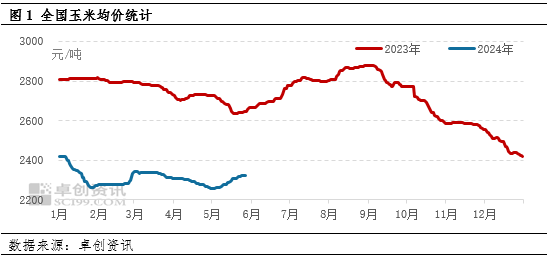
Since May, the national average corn price has gradually risen, which is the longest rising cycle since the new grain was listed in September 2023. As of the 27th, the national average corn price was 2,321.99 yuan/ton, up 64.61 yuan/ton from the end of April, a cumulative increase of 2.86%, but still 12.19% lower than the same period last year.
Grassroots surplus grain decreases, farmers and traders are reluctant to sell
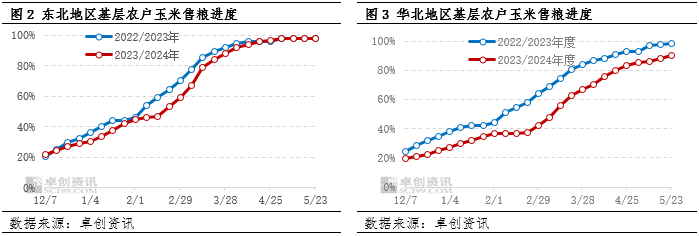
According to Zhuochuang Information monitoring data, as of April 30, the sales progress of grassroots corn in Northeast China was 97%, and the sales of grassroots corn surplus grain entered the final stage; in North China, it was 85%. Although the grassroots surplus grain was more than in previous years, the price of corn fell to a staged low. Since May, grassroots farmers have been reluctant to sell, and corn shipments have been limited. With the reduction of grassroots corn supply, the market grain supply is limited, and most traders have shipped at prices below the cost line, and the enthusiasm for shipment is low. Therefore, the overall supply of corn in the market has tightened compared with April.
Since May, the purchase price of corn deep processing enterprises in Shandong Province has increased as the number of vehicles arriving has decreased. As of the 27th, the average purchase price of corn by corn deep processing enterprises in Shandong Province was 2,329 yuan/ton, a cumulative increase of 3.85% from April 30. Grassroots farmers and traders have increased their confidence in the future market and are reluctant to sell, so the supply of corn in mid-to-early May was tight. Starting from late May, as prices rebounded, some grassroots farmers became more enthusiastic about selling grain, and the amount of grassroots corn increased. At the same time, some traders shipped in moderation, and the effective supply of corn in the market increased slightly. However, supported by the storage cost, traders were still reluctant to sell at low prices, so the increase in corn supply was limited.
As of May 24, the progress of corn sales at the grassroots level in Northeast China was 98%; in North China, it was 90%, gradually entering the final stage. At the same time, as the end of May approaches, traders in North China have completed their warehouse clearance plans. In June, as North China gradually enters the middle stage of wheat collection, farmers' corn shipments may decrease. Traders mainly operate wheat, and corn shipments may be relatively limited. Therefore, the effective supply of corn in North China may be tight in June. Supported by the cost of grain storage, traders in Northeast China may not be motivated to increase shipments, and the effective supply of corn is relatively limited. Overall, the effective supply of corn in the market may still be tight in June.
Deep processing and feed companies mainly purchase on demand
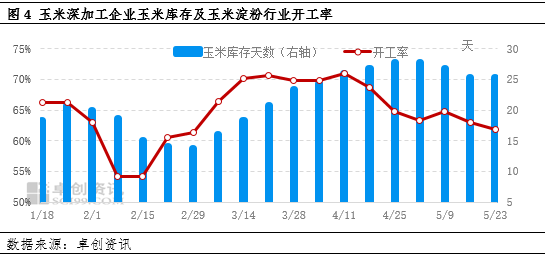
Since late April, corn deep processing companies have completed their warehouse construction plans. In May, deep processing companies generally focus on rolling inventory replenishment, and corn stocks are relatively stable. Although the operating rate of the corn starch deep processing industry has fallen slightly since May, as of May 24, the industry's operating rate has fallen to 61.79%, but it is still 8.01 percentage points higher than the same period last year. At the same time, the operating rate of starch sugar companies has increased. Overall, the corn consumption in the corn deep processing industry is relatively stable. In June, as some companies are undergoing maintenance, the operating rate of corn deep processing companies may decline, and corn consumption may decrease.
In terms of feed use, feed production was relatively stable in May, but some feed companies had orders for rice mixtures, imported sorghum and barley in the early stage. With the use of related substitutes, the use of domestic corn by some companies has slightly decreased. In addition, with the concentrated listing of wheat, some feed companies may increase their purchases of wheat if the wheat toxins meet the standards, but wheat needs to go through the post-ripening period before entering feed production. Therefore, the demand for feed corn may be stable in the short term, and the use of feed corn may slightly decrease in the later period due to the use of substitutes.
There is still room for corn prices to rise in June
In terms of supply, North China entered the wheat harvest period in June, and supported by the warehousing costs of traders, the effective supply of corn in June may still be tight; in terms of demand, the demand for deep-processed corn has slightly decreased, the demand for feed is relatively stable, and the demand for corn may slightly decrease. On the whole, the supply side will continue to support corn prices in June, but demand limits price increases, and it is expected that corn prices will still have a narrow range of room for increases in June.
Source: Zhuo Chuang Information)