

[Introduction] Starting in December, raw material corn prices fluctuated and rose, increasing cost pressures on MSG manufacturers. Production costs played a stronger role in driving up prices, resulting in a strong start to 2026 for the MSG market, with prices continuing to rise. Costs remained high in February and March, coupled with the positive factor of gradually recovering demand after the Spring Festival, suggesting that MSG prices may maintain a relatively strong trend.
MSG Market Prices Continued to Rise in January, with Divergent Price Increases Across Different Crystal Forms
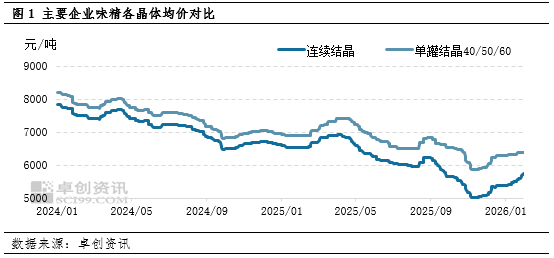
MSG market prices continued their upward trend in January. Although overall demand remained stable, with the gradual digestion of previously low-priced supplies, the boost was insufficient. However, manufacturers actively maintained prices and showed a relatively unified willingness to raise them, playing a subjective role in driving up MSG prices, especially for fine crystals, where reduced supply led to a more significant price increase. According to data from Zhuochuang Information, as of January 29, the mainstream transaction price of large-package MSG (40-60 mesh) from major MSG manufacturers was 6,100-6,650 yuan/ton, an increase of 50 yuan/ton compared to the beginning of the month. Meanwhile, the mainstream intended price for 80 mesh MSG was 5,700-5,850 yuan/ton, an increase of 275 yuan/ton compared to the beginning of the month.
Increased Production Costs Force MSG Manufacturers to Raise Prices and Pass on Pressure
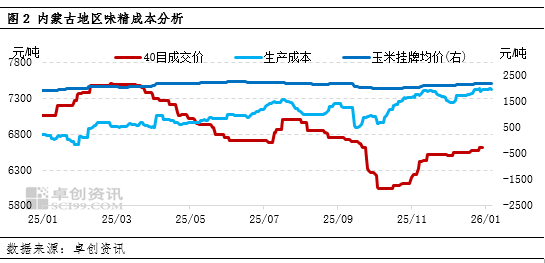
Corn, coal, and sulfuric acid are the main raw materials and auxiliary materials for MSG production. In January, corn prices in Northeast China continued to rise, fundamentally due to a tight supply-demand relationship. Throughout the month, farmers in the producing areas maintained a reluctance to sell, leading to a continued increase in the price of moist corn at the grassroots level. Downstream processing enterprises and trading entities actively purchased corn, with most deep-processing enterprises raising prices to encourage purchases. In the middle of the month, some traders and processing enterprises stocked up for the Spring Festival, increasing market demand. At the same time, policy grain continued to be released into the market, further supplementing market supply and alleviating the procurement cost pressure on some enterprises. As of January 29, the average monthly purchase price of corn by major enterprises in Inner Mongolia was 2189.8 yuan/ton, an increase of 3.4% compared to the previous month. In addition, the price of sulfuric acid has also gradually increased along with the rise in the price of raw material sulfur, with the average monthly price at RMB 1,046.2 per ton, up 0.4% from the previous month. Under the influence of the trend of high and strong prices of some raw materials, the cost of MSG raw materials per ton is RMB 7,428.5, up 2.6% from the same period last month, resulting in a significant increase in production costs. MSG companies have successively raised prices to pass on the pressure.
MSG prices are expected to continue their upward trend in February and March.
Supply and Demand: Leading companies maintained stable operations, but production capacity in Heilongjiang Province remained abnormal, coupled with tight supply of some crystalline products, leading to supply gaps in some local markets. On the demand side, the Spring Festival holiday shortened the overall purchasing and sales period in February. Pre-holiday market transactions were generally low, but post-holiday restocking demand from downstream end-users and traders gradually increased, providing some support to demand. However, the overall recovery may be limited. On the cost side: In the first half of February, farmers in Northeast China continued to actively sell grain, increasing supply at the grassroots level, but the willingness to hold prices remained strong, keeping market prices relatively firm. Downstream processing companies maintained a just-in-time purchasing model, and some companies and feed companies in sales areas had nearly completed their pre-holiday stockpiling, limiting the potential increase in demand and narrowing the price increase in Northeast China. In the second half of February, the market entered the Spring Festival holiday, with purchasing and sales volume dropping to a low level, and market prices remaining stable. Overall, the price of corn in Northeast China rose first and then stabilized in February, with an increase of about 10 yuan/ton.
In summary, cost pressures and tight supply in February and March will support upstream companies' willingness to maintain prices, and the market is likely to remain at a high level with a slight upward trend. Leading companies will continue to drive the price center upward. However, downstream markets are showing strong rationality and a wait-and-see attitude, with limited acceptance of high-priced goods. Intense competition and lagging price increases in sales areas will limit the potential for significant price increases. The average price of 40-mesh ore in Inner Mongolia is expected to be 6,590 yuan/ton in February and 6,680 yuan/ton in March.
Source: Zhuo Chuang Information)