

[Introduction] Entering mid-to-late May, the wheat starch market continued its downward trend. While substitutes provided some support, wheat starch demand itself remained weak. Coupled with unfavorable cost factors, factories continued to lower prices to stimulate sales. Domestic demand showed no significant improvement expected, and the price of raw material flour (a downstream product) fell considerably. Wheat starch prices are expected to decline from late May to early June.
Entering mid-to-late May, the wheat starch market continued its downward trend, widening the price gap with corn starch and strengthening the positive impact of substitutes. However, wheat starch demand itself remained weak, with end-user demand still recovering. Distributors and food processing companies were slowly depleting their inventories, and the price decline dampened downstream purchasing activity, resulting in no improvement in transactions and increased supply pressure. Furthermore, the decline in raw material flour prices further weakened the market, contributing to the overall decline in wheat starch prices. As of May 22, the mainstream market price range for secondary dehydrated wheat starch was 2,700-2,850 yuan/ton, with an average market price of 2,775 yuan/ton. This represents a decrease of 0.54% compared to the average price at the beginning of the month, a decrease of 2.63% compared to the end of last month, and an increase of 4.72% year-on-year.
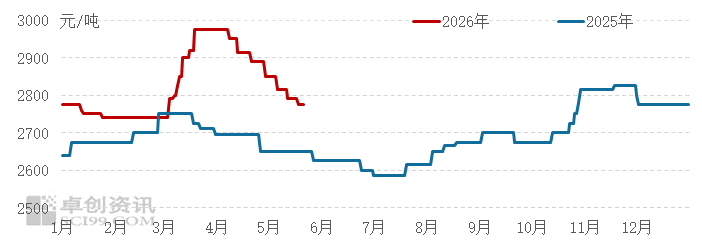
Raw material flour prices fell, negatively impacting the market from a cost perspective.
Entering May, raw material flour prices saw a significant decline. Wheat prices initially fell before rising, and the earlier drop reduced flour mill costs. Furthermore, rising prices of by-products increased the bargaining power for flour. Additionally, a decrease in the operating rate of the wheat starch industry reduced demand for flour, further contributing to the price decline. As of May 22nd, the average price of raw material flour delivered to wheat starch plants in Henan province was 2800 yuan/ton, a decrease of 80 yuan/ton (2.78%) compared to the end of last month, negatively impacting wheat starch costs.
Substitutes provided stronger support, but demand for wheat starch itself remained weak.
As wheat starch prices continued to fall, the price difference with corn starch widened. As of May 22nd, the average price of corn starch in Shandong province was 130 yuan/ton higher than the national average price of wheat starch, strengthening the positive impact of substitutes.
Demand for wheat starch itself is weak, with end-user demand still recovering. Downstream distributors and food processing companies are slowly depleting their inventories and are not very active in inquiries. Coupled with the decline in prices, which is detrimental to downstream inquiries, transaction volume is limited, and supply pressure is increasing.
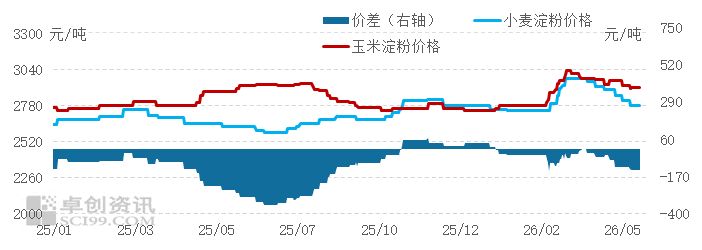
Wheat starch prices are expected to decline from late May to early June.
Looking ahead to late May to early June, downstream demand is not expected to improve significantly, and market supply pressure remains. Coupled with the recent substantial drop in downstream starch prices, and with no significant improvement in transaction volume expected, factories are expected to further lower prices to stimulate sales, with a potential decline of around 30 yuan/ton. In the medium to long term, close attention needs to be paid to the new wheat harvest. While some producing areas have experienced poor yields due to rainfall, the impact is currently minimal, but continued monitoring is still necessary.
Source: Zhuo Chuang Information