

What is the solubility of sorbitol in water?
As a sorbitol supplier, I often receive inquiries about the solubility of sorbitol in water. Understanding the solubility of sorbitol is essential for various industries, including food, pharmaceuticals, and cosmetics. In this blog, I will delve into the science behind sorbitol's solubility, its influencing factors, and its practical applications.
The Basics of Sorbitol Solubility
Sorbitol, also known as D - glucitol, is a polyol with a sweet taste. It is a white, odorless, crystalline powder or granules at room temperature. When it comes to solubility in water, sorbitol is highly soluble. At 20°C, approximately 1.7 g of sorbitol can dissolve in 1 mL of water. This means that it can form concentrated solutions in water with relative ease.
The solubility of sorbitol in water is influenced by several factors. Temperature plays a crucial role. As the temperature increases, the solubility of sorbitol also increases significantly. For instance, at 80°C, the solubility of sorbitol in water can reach up to about 2.8 g/mL. This property is quite useful in industrial processes where high - concentration solutions are required.
Molecular Structure and Solubility
The high solubility of sorbitol in water can be attributed to its molecular structure. Sorbitol has multiple hydroxyl (-OH) groups in its molecule. These hydroxyl groups are polar, and they can form hydrogen bonds with water molecules. Hydrogen bonding is a strong intermolecular force that allows sorbitol molecules to interact favorably with water molecules. When sorbitol is added to water, the water molecules surround the sorbitol molecules, breaking the intermolecular forces between sorbitol molecules and allowing them to disperse in the water, resulting in a solution.
Practical Applications in Different Industries
Food Industry
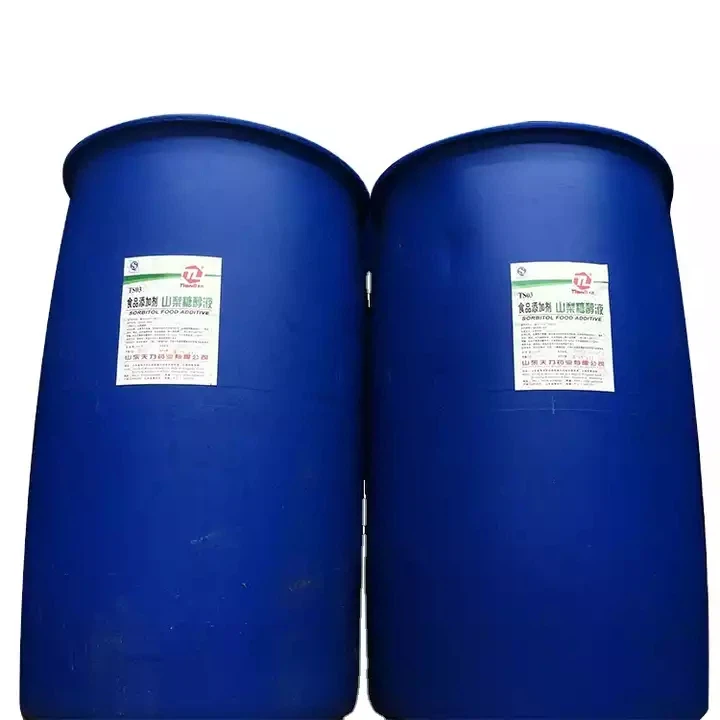
In the food industry, the high solubility of sorbitol makes it an ideal sweetener and humectant. It can be used in a wide range of food products, such as confectionery, beverages, and baked goods. For example, in making candies, sorbitol's solubility allows it to dissolve easily in the syrup during the manufacturing process, providing a sweet taste and preventing the crystallization of sugar. Our Sweetness Sorbitol Solution Liquid is a popular product in the food industry. It is pre - dissolved sorbitol, which saves the processing time and ensures a uniform sweetening effect in food products.
Sorbitol is also used in dietetic products. Since it has a lower calorie content compared to sucrose, it is a suitable alternative for people who need to control their calorie intake. Its solubility ensures that it can be easily incorporated into low - calorie drinks and snacks.
Pharmaceutical Industry
In the pharmaceutical field, sorbitol's solubility is exploited in various ways. It is used as a vehicle for drug delivery, especially in liquid formulations. Drugs can be dissolved or suspended in sorbitol solutions, which are stable and can improve the bioavailability of some drugs. For example, in oral syrups, sorbitol not only provides a sweet taste to mask the bitter taste of drugs but also helps in dissolving and stabilizing the active ingredients. Our Sorbitol Syrup 70% CAS 50 - 70 - 4 is commonly used in pharmaceutical preparations due to its appropriate concentration and high solubility properties.
Cosmetics Industry
The cosmetics industry also benefits from sorbitol's solubility. It is used in skin - care and hair - care products as a moisturizer. When added to creams, lotions, and shampoos, its solubility allows it to blend well with other ingredients. Sorbitol attracts water to the skin or hair, helping to keep them hydrated. Our Sorbitol Liquid for Toothpaste is a prime example. In toothpaste, sorbitol not only provides a sweet taste but also acts as a humectant, preventing the toothpaste from drying out.
Quality and Purity Influence on Solubility
It's important to note that the solubility of sorbitol can be affected by its quality and purity. Impurities in sorbitol can interfere with the hydrogen - bonding process between sorbitol and water molecules, reducing its solubility. As a sorbitol supplier, we ensure that our products meet high - quality standards. Our sorbitol is produced through advanced purification processes, which minimize the presence of impurities, thus guaranteeing optimal solubility in water.
Measuring Sorbitol Solubility
To measure the solubility of sorbitol in water accurately, a common method is to add a known amount of sorbitol to a fixed volume of water at a specific temperature and stir the mixture until no more sorbitol can dissolve. The excess undissolved sorbitol is then filtered out, and the solution is analyzed to determine the amount of dissolved sorbitol. This can be done through techniques such as refractometry or gravimetric analysis.

Conclusion
In conclusion, the solubility of sorbitol in water is a key property that makes it a versatile and valuable ingredient in multiple industries. Its high solubility, which is mainly due to its molecular structure and is enhanced by temperature, enables it to be used in various applications from food and pharmaceuticals to cosmetics.
If you are in need of high - quality sorbitol products for your industrial applications, we are here to provide you with the best solutions. Our sorbitol products are known for their excellent solubility and purity. Whether you are looking for a sweetener for your food products, a vehicle for drug delivery, or a moisturizer for cosmetics, we have the right sorbitol product for you. We welcome you to contact us for procurement and further discussions on how our sorbitol can meet your specific needs.
References
- Handbook of Industrial Chemical Additives, Second Edition. Nigel P. Cheremisinoff.
- The Wiley Encyclopedia of Food Science and Technology. Fereidoon Shahidi.